How to Choose an Automatic Diaper Making Machine in 2026?
Choosing an Automatic Diaper making machine in 2026 is not just a speed decision. A line rated for high output may still struggle with product changes, material variation, or frequent stops. The useful question is whether it can make your target products consistently, shift between sizes efficiently, and fit the factory you actually operate.
Look beyond the headline production rate. Examine sample diapers for core placement, seal quality, leg gathers, and absorbency consistency. Ask to see a live run using materials similar to yours. Watch how long changeovers take, how operators clear a fault, and whether the control screen explains problems clearly. Small details matter. Request data on scrap, energy use, maintenance intervals, and service response times, then compare the full operating cost—not only the purchase price.
Manufacturing quality expert W. Edwards Deming wrote, “Quality comes not from inspection, but from improvement of the production process.” Deming was not a diaper-machine specialist, but his principle is relevant: equipment, materials, training, and process control work together. Use it when assessing automation, inspection systems, and supplier support. Ask for references from factories producing comparable products, and verify what the quoted output includes. A specification sheet cannot show every real-world limitation. That is easy to overlook. No machine is perfect, and my own first comparison would still need a factory trial. This guide outlines the questions that help buyers make a more informed choice.
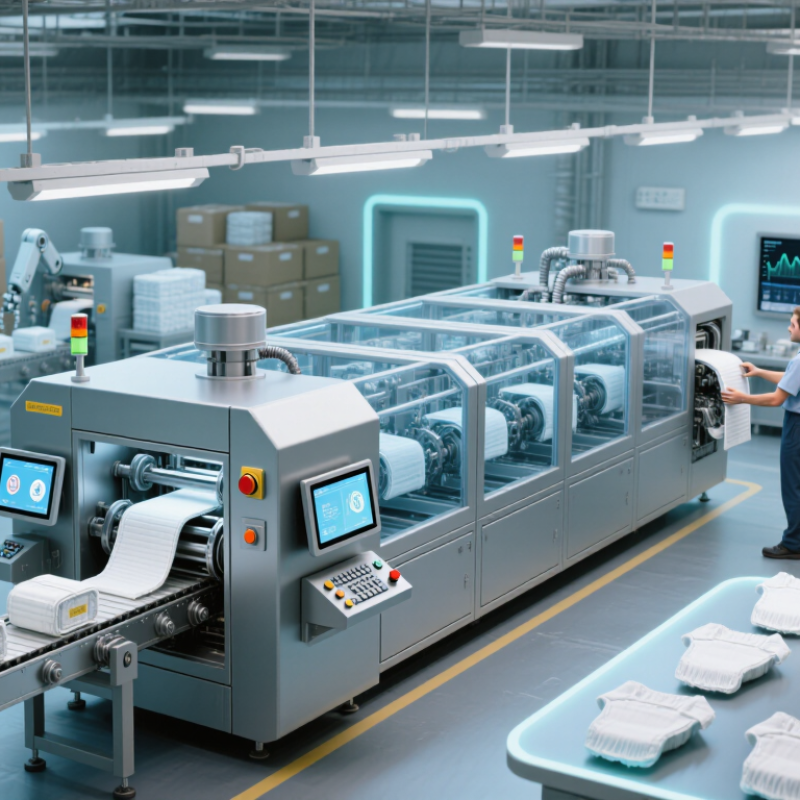
Define Product Requirements: Baby, Adult, or Pants Diapers and Size Range
Before selecting an automatic diaper making machine, define the product mix: baby diapers, adult briefs, or pull-on pants. Each format needs different forming, folding, elastic placement, and sealing arrangements. A line set up for taped baby diapers may not switch efficiently to pants. Ask suppliers to demonstrate changeovers using your intended materials, not just sample photos. Small details matter.
For baby products, specify weight bands and the overlap between sizes. For adult products, define waist or hip measurements, absorbency levels, and whether the product is a brief or pant. WHO’s Child Growth Standards provide age- and sex-specific growth references, but they do not replace local fit trials. Fit varies. Build a size matrix from measured users and test leg cuffs, waist tension, and leakage with actual samples.
Demand forecasts can guide capacity, but they should not dictate product choice alone. WHO’s 2024 ageing fact sheet reports that one in six people worldwide will be aged 60 or older by 2030, underscoring the need to assess adult-care formats alongside baby products. Record each SKU’s target output, size range, core and cuff materials, and acceptable changeover time. Then match machine configuration to that list. Be cautious: a wide size range sounds attractive, yet frequent adjustments can reduce output and increase scrap. Include realistic trial data in the purchase specification.
Compare Rated Capacity: Baby Diaper Lines Commonly Run at 400–800 Pieces/Min
When choosing an automatic diaper making machine in 2026, compare rated capacity with your actual product mix. Baby diaper lines commonly list speeds of 400–800 pieces per minute. On paper, that equals 24,000–48,000 pieces per hour. Real output is usually lower. Stops for material changes, adjustments, and rejected products reduce the count.
Ask what conditions support the quoted speed. Does it apply to a specific diaper size, absorbent-core design, or material combination? A line may run faster on one configuration than another. That matters. Request a trial using your target product, and record good pieces per minute over a sustained run. Also check whether the figure includes stacking and packaging, or only the forming section.
A small gap can reshape production plans. At 600 pieces per minute, a five-minute stop represents 3,000 pieces of theoretical output. Not always recoverable. Compare uptime, changeover time, scrap rate, and staffing needs alongside the headline rating. I would question any capacity figure without test conditions and a clear definition of acceptable product. Those details are less exciting than a top-speed number, but they make the comparison more reliable.
How to Choose an Automatic Diaper Making Machine in 2026?
Compare rated capacity: baby diaper lines commonly run at 400–800 pieces per minute.
The chart compares illustrative rated speeds within the 400–800 pieces-per-minute range. The hourly figures are theoretical outputs calculated by multiplying rated speed by 60; actual production may be lower because of downtime, changeovers, and operating conditions.
Assess Core Modules: SAP, Elastic Placement, Hot-Melt Application, and Inspection
In 2026, compare diaper machines by what their core modules can prove under production conditions. EDANA’s 2023 statistics reported roughly 2.4 million tonnes of European nonwovens production in 2022, highlighting the scale of a key hygiene-material supply chain. That figure is context, not a capacity target. For SAP dosing, request test records showing feed-rate stability and absorbent-core weight across the full operating range. Check samples from the center and edges of the web. Small differences matter. Uneven SAP can create bulky zones or weak absorption. Ask how quickly operators can clear a bridge or refill the hopper without disrupting the line.
For elastic placement, inspect tension control, splice handling, and registration while the web accelerates and slows. A clean sample at steady speed proves little. Hot-melt application should be assessed by adhesive pattern, coat-weight consistency, temperature control, and stringing after a stop-start cycle. Request measurements, not just photographs. Inspection systems should detect misplaced elastics, open seals, and visible core defects, then link each reject to a clear reason. Confirm detection limits using seeded defects and review false-reject rates. One uncomfortable point: a faster line may produce more waste if inspection and rejection cannot keep pace. Trial the modules together with your own materials. A polished demonstration is not enough.
Verify Compliance: ISO 9001 Quality Systems and IEC 60204-1 Machine Safety
How to Choose an Automatic Diaper Making Machine in 2026?
A machine’s output rate matters, but so does the evidence behind its quality and safety claims. Ask whether the supplier’s ISO 9001 certificate covers the manufacturing site and activities involved. ISO 9001 concerns a quality management system; it does not certify a particular diaper machine. Review how the factory controls design changes, component inspection, testing, and nonconformities. Request sample inspection records and confirm that the documents match the machine configuration you are buying.
For electrical safety, ask for a documented assessment against the applicable edition of IEC 60204-1. Check the control cabinet, wiring diagrams, protective bonding, emergency-stop circuits, and labeled disconnects. On the production floor, inspect guards around rotating rollers and verify that interlocks stop hazardous motion when access doors open. Paperwork can look tidy while a real changeover reveals awkward access or unclear controls. I would not treat a certificate alone as proof that every installed option has been assessed.
Tips: Compare document versions with the machine’s serial number and options list. Ask who tested the emergency stops and when. Request a witnessed run, then observe a real roll change and jam-clearing procedure. Keep a little skepticism; even a thorough checklist can miss a practical usability problem.
Calculate Lifecycle Cost: Energy, Labor, Scrap, Changeovers, and Spare Parts
When choosing an automatic diaper making machine in 2026, compare lifecycle cost, not just the purchase price. Track electricity use during production, startup, and idle periods. Estimate annual energy cost by multiplying measured kilowatts by operating hours and your local rate. A short production trial can reveal whether actual consumption matches the supplier’s figures. That matters.
Labor costs depend on how many operators are needed for routine running, quality checks, and roll changes. Record staffing across a full shift, not only during a smooth demonstration. Scrap also adds up: include rejected products during startup, web breaks, and size adjustments. Changeovers can quietly reduce output. Measure minutes lost when changing sizes or materials, then estimate the saleable units missed. Ask for spare-part prices and expected lead times for blades, sensors, belts, and sealing components. A low-cost part can still be expensive if its arrival stops the line. Forecasts are imperfect, and real production rarely behaves exactly like a trial. Keep your assumptions visible, and revisit them after installation.