
An Antique Dressing Table is more than a mirror and a row of drawers. Its shape can reveal changing ideas about privacy, display, and daily grooming. Queen Anne pieces often feel restrained, with cabriole legs and warm walnut. Rococo Revival tables add carved curves, while Victorian examples may pair dark timber with elaborate mirrors. Later Edwardian and Art Deco designs favor lighter lines and cleaner geometry. The differences are visible up close.
The wider furniture market offers useful context, though not a direct measure of antiques. Grand View Research estimated the global furniture market at about $729.6 billion in 2024. That figure covers furniture broadly; it does not isolate antique dressing tables. For collectors, condition and construction matter more than market headlines. Check drawer joints, veneer edges, mirror plates, and signs of later repair. A glossy finish can hide as much as it reveals.
Furniture historian Christopher Payne’s research on historic furniture suggests a useful principle. In paraphrase: “Read the piece through its materials, construction, and condition.” This is a practical lens, not a verified verbatim quotation. Look closely. A worn brass pull, a slightly uneven mirror, or a repaired leg can tell a fuller story than a style label alone. This guide explores ten recognizable styles, while acknowledging that real pieces often blend periods. Some resist neat categories. That is part of their appeal.
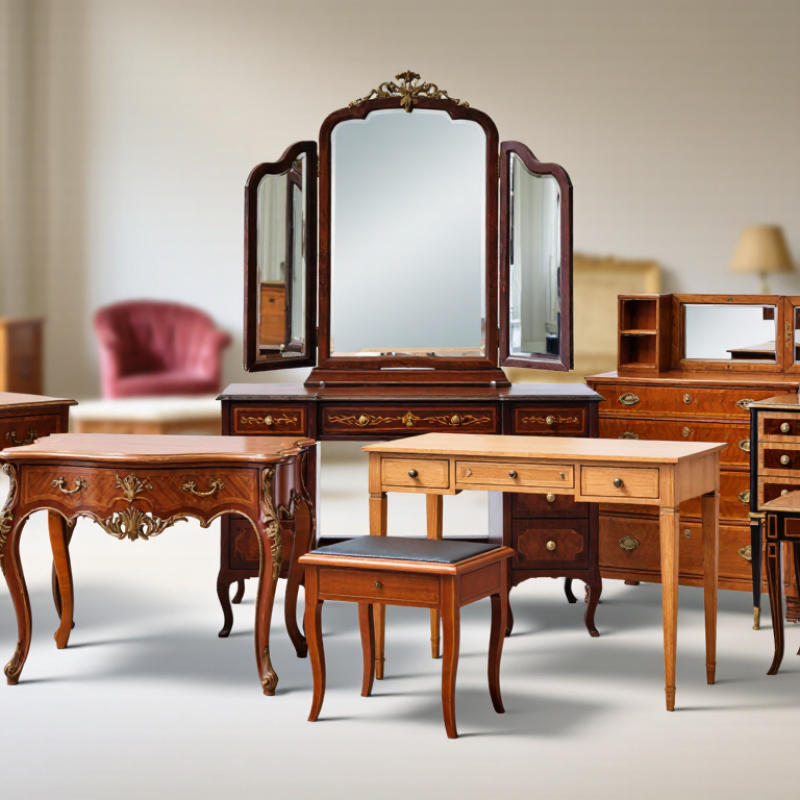
An antique dressing table is more than an old piece with a mirror. Its age, materials, construction, and design should tell a reasonably consistent story. Collectors often look for solid wood, hand-cut joints, and hardware that fits the table’s period. Yet no single feature proves age. Replaced handles or a later mirror can complicate the picture.
Look closely at the details. Dovetail joints may vary slightly in size, while older finishes often show gentle wear around drawer pulls and edges. A folding mirror might have pivoting supports, and small drawers may hold combs or grooming tools. The wood can reveal clues, too: grain patterns, veneer, and wear inside drawers sometimes differ from what a fresh polish suggests. Patina matters, but dirt alone is not proof.
Look underneath as well. Check for modern screws, thin machine-made panels, or repairs that do not match the rest. These clues may point to later changes, not necessarily a false antique. Dating takes judgment. Sometimes the evidence remains mixed, and that uncertainty deserves a place in the description. A careful assessment combines visible details with provenance, when available, rather than relying on style alone.
People have groomed before mirrors for centuries. Dedicated dressing tables became more prominent in European homes during the seventeenth and eighteenth centuries. Earlier examples often paired a cabinet or writing desk with a small mirror. Privacy mattered, especially when grooming took place in a bedroom.
Baroque tables favored rich ornament and dramatic curves. Queen Anne designs introduced graceful cabriole legs, while Chippendale examples often featured more elaborate carving. Later neoclassical and Federal styles leaned toward symmetry and restrained decoration. The Victorian era brought heavier forms, dark finishes, and practical drawers for brushes and linens. The timeline is not tidy; regional tastes and household budgets shaped each piece.
Around the turn of the twentieth century, Art Nouveau designers used flowing lines inspired by plants. Edwardian tables often looked lighter, with delicate details and brighter finishes. Art Deco brought geometric shapes and polished surfaces, followed by mid-century pieces with simpler profiles and less ornament.
These changes reflect more than fashion: they also show how mirrors, lighting, and personal routines shifted. A surviving table can reveal wear around its drawer pulls or faded patches where a mirror once stood. Small clues, but useful ones. Not every old table fits one style neatly, and that uncertainty is part of its history.
Antique dressing tables range from restrained Georgian forms to highly decorative Victorian pieces. Georgian examples often have straight lines, small drawers, and warm-toned wood such as mahogany. Regency designs may pair polished surfaces with brass details and a separate adjustable mirror. Victorian tables tend to be taller and more ornate, with carved legs or shaped drawer fronts. Edwardian styles often feel lighter, using slimmer frames and modest inlay. Look closely at proportions, not just ornament. They tell a story.
French Louis XV tables are known for curved legs and flowing outlines, while Louis XVI examples favor symmetry, tapered legs, and delicate classical motifs. Empire dressing tables can feel more imposing, with strong shapes and dark finishes. Art Nouveau pieces bring flowing lines inspired by plants, sometimes echoed in mirror frames or carved details. Not always tidy. Styles overlap, and later repairs can soften the clues.
Arts and Crafts dressing tables usually emphasize visible wood grain, sturdy construction, and restrained decoration. Campaign-style examples are compact and practical, sometimes with removable mirrors or simple metal fittings. For any style, inspect drawer movement, joints, veneer, and the back of the piece. Wear can support an age estimate, but it is not proof by itself. A polished surface may hide repairs, and restorations can make an old table look surprisingly new.
Antique dressing tables are easiest to identify by looking at their legs, drawer fronts, mirror supports, and ornament. Queen Anne examples often have cabriole legs ending in pad feet and restrained curves. Georgian pieces usually look more balanced, with straight lines and symmetrical drawers. Chippendale tables may show ball-and-claw feet, pierced motifs, or bold carved knees. Federal styles favor slender legs, light proportions, and fan-shaped inlays. Look closely. One feature alone rarely proves a date or style.
Victorian dressing tables often feel substantial, with dark wood, turned supports, and elaborate mirrors. Rococo Revival pieces lean toward carved shells, leafy scrolls, and sweeping curves. Eastlake designs use flatter surfaces, geometric carving, and repeated incised lines instead of deep ornament. Art Nouveau examples can be recognized by flowing, plant-like details and asymmetrical outlines. The curves may look almost vine-like. Check whether the mirror frame and base share the same decorative language.
Arts and Crafts tables tend to have visible joinery, sturdy proportions, and simple hardware. Art Deco examples usually show clean geometry, stepped forms, and high-contrast materials or finishes. I still find borderline pieces tricky: later repairs can change handles, mirrors, or feet. Compare several clues, and inspect drawer construction and wear before settling on an attribution. A replacement mirror, especially, can confuse the picture.
A dressing table’s age is best judged through several clues, not one decorative detail. Look underneath the top and inside the drawers. Hand-cut dovetail joints may suggest earlier construction, while evenly spaced machine-made joints often point to later production. These clues are not exact dates. Repairs and reused parts can confuse the picture.
Check the finish in low, angled light. Fine scratches, faded patches, and darker areas around handles can show years of use, but heavy wear does not prove great age. Examine the mirror for cloudy spots, small losses to the silvering, and movement in its frame. Some older glass looks slightly uneven; replacement mirrors may look clearer. Open each drawer and note whether it slides smoothly, then inspect the runners, corners, and legs for looseness, cracks, or fresh filler. Feel for lifting veneer, but do not press hard. A little wobble matters. It may come from a loose joint, not a ruined table. Record what you find, including repairs, and compare the details with reliable furniture references. I would avoid confident dating from photographs alone; one polished surface can hide a complicated history.
| Style | Approximate Period | Common Identifying Features | Age and Condition Checks |
|---|---|---|---|
| Queen Anne | Approximately 1700–1755 | Graceful proportions, curved cabriole legs, restrained ornament, and often walnut or mahogany. Many examples have a separate looking glass rather than a mirror attached to the table. | Check that legs and feet are sound and that the table sits level. Look for old repairs around leg joints and confirm that drawer construction and surface wear are consistent with the claimed age. |
| Chippendale | Approximately 1750–1790 | May feature cabriole or straight legs, carved knees, claw-and-ball feet, pierced fretwork, or elaborate handles. The style includes several design influences, so not every piece has the same details. | Inspect carved areas for chips, later replacements, or freshly cut-looking details. Test drawer movement and examine the underside for evidence of alterations or modern fasteners. |
| Hepplewhite | Approximately 1775–1820 | Typically has a lighter, neoclassical appearance, tapered legs, shield-shaped motifs, and delicate inlay or contrasting veneers. Oval or shield-shaped mirrors appear on some dressing tables. | Check slender legs for splits and instability. Examine veneer edges and inlay for lifting or missing sections; replacement mirror glass alone does not necessarily indicate that the frame is recent. |
| Sheraton | Approximately 1780–1820 | Characterized by straight lines, tapered legs, fine inlay, and restrained neoclassical decoration. Some pieces have a small mirror mounted above the top. | Look for consistent wear on the feet and around drawer pulls. Inspect thin legs and inlaid areas closely, as repairs or replaced sections can be difficult to spot at a glance. |
| French Provincial | Broadly, 18th century; regional examples vary | Often combines curved legs and shaped fronts with simpler, locally made decoration. Painted finishes, carved details, and lighter-colored woods are found on some examples. | Distinguish an old painted surface from a recent decorative finish by checking protected areas, such as the back and inside drawers. Look for woodworm exit holes, but remember that holes alone do not prove active infestation. |
| Regency | Approximately 1811–1837 | Often features stronger geometric forms, tapered or turned legs, dark woods, brass details, and classical or architectural ornament. Dressing tables may have a tilting mirror supported by uprights. | Check the mirror supports and joints for looseness, and look for replacement brass fittings. Inspect veneered surfaces for bubbling, cracks, and repairs around corners. |
| Victorian | Approximately 1837–1901 | Frequently heavier and more decorative, with carved details, turned elements, marble tops, and large mirrors. Designs range from revival styles to simpler forms. | Check marble for cracks and the supporting frame for movement. Look for replaced mirror plates, loose carving, and veneer lifting; a Victorian date does not guarantee that every component is original. |
| Art Nouveau | Approximately 1890–1910 | Known for flowing, asymmetrical lines and nature-inspired motifs such as leaves and flowers. Some dressing tables incorporate curved mirror frames and sculptural details. | Examine curved or carved sections for breaks and repairs. Check mirror mounts and any decorative inlay or applied ornament, which can loosen over time. |
| Edwardian | Approximately 1901–1910, with related designs continuing later | Often lighter and less heavily ornamented than many Victorian examples, with pale finishes, fine inlay, tapered legs, and small mirrors or washstand-inspired features. | Check delicate legs, thin veneers, and drawer bottoms for damage. Confirm that any pale finish has not been substantially stripped or replaced if originality matters to you. |
| Art Deco | Approximately 1920s–1930s | Features streamlined geometric shapes, stepped forms, bold contrasts, and highly polished surfaces. Some examples use veneers arranged in striking patterns. | Inspect glossy finishes for cracking, cloudy areas, and refinishing. Check patterned veneers for lifting and confirm that handles, feet, and mirror fittings are secure and consistent with the piece. |
Dating and condition note: Periods are approximate, and style names describe design rather than proving when a particular table was made. For a more reliable assessment, inspect the construction, joints, drawer interiors, hardware, underside, finish, repairs, and any signs of later alteration. A qualified furniture appraiser or conservator can help assess unusual or valuable pieces.